“MIT brain scans suggest that using GenAI tools reduces cognitive activity. ..AI users displayed shorter memory and significantly fewer connections between regions of the brain.”
Frankly, I had been wondering about this for some time. My worry primarily stemmed from a personal bias I have against the widespread practice of “benhmarkig,” a widespread marketing and management tool copmanies use to identify best practices used by other firms. The idea is that the enterprise should investigate highly successful comanies and see what they do that hs helped them to be successful.
While this seems like a good idea, the problem I have with it is that you are settling for what has already been done, instead of using creativity to come up with different—sometimes paradigm-breaking—factors that aren’t being explord, as all the rewearch funding goes into benchmarking.
“A recent study from MIT strongly supports this concern, indicating that the use of digital tools significantly alters brain activity.
“The newly published paper explains that as participants in an experiment wrote a series of essays, electronic brain monitoring revealed substantially weaker connections between regions of the brain in those who used large language models (LLMs). This correlated with poorer memory and more derivative output.”
This is a real eye-opener and not to be missed.
“WHY IT MATTERS: As the use of generative AI becomes increasingly common in education, law, politics, media, and other fields, many worry that reliance on the technology may reduce cognitive independence. A recent study from MIT strongly supports this concern, indicating that the use of digital tools significantly alters brain activity.”
It turns out that I wrote my previous post about CarFax without all the information I should have had.
Apparently, it isn’t just OEM automobile service centers that subscribe to CarFax, many independent shops also report the work they do on your vehicle.
But not all shops do. That’s why CarFax is not always factual—it might not have received all the facts about work that’s been done!
In talking with some service technicians that I know personally, it seems that the best way to know the facts about a used vehicle you are thinking of buying is to have it checked out by a reputable independent shop that either you or a good friend of yours knows to be 100% honest. Pay for an inspection that can help you decide whether the vehicle you are thinking about buying is a good deal or not.
DON’T RELY ON A CARFAX REPORT TO TELL YOU THE FULL HISTORY OF ANY USED CAR!!!
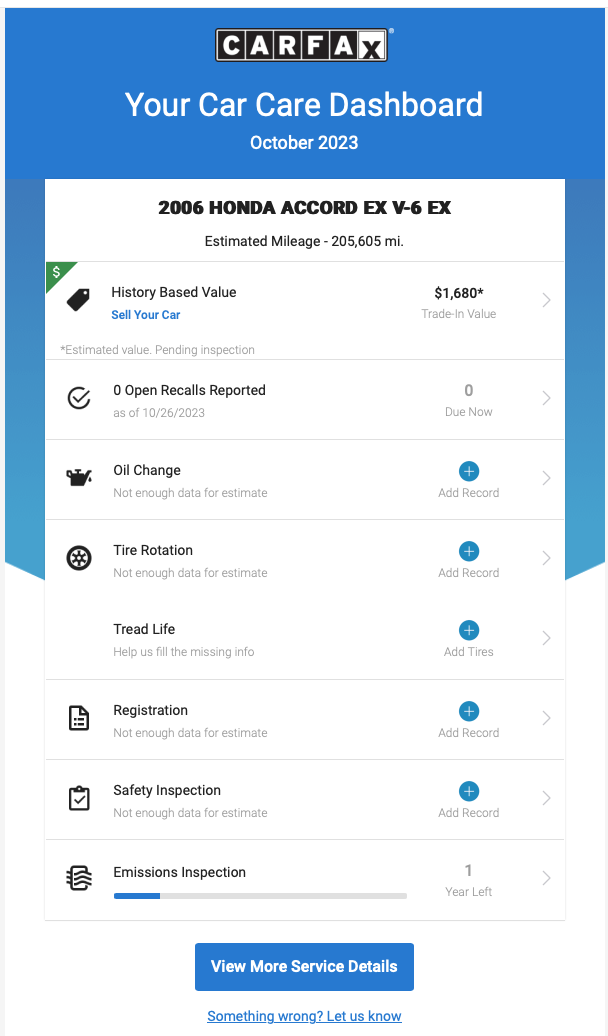
On October 27, 2023, I got an email alert from CARFAX about my 2006 Honda Accord EX V-6 that showed what it knew and did not know about my car, with an estimated value of $1680.
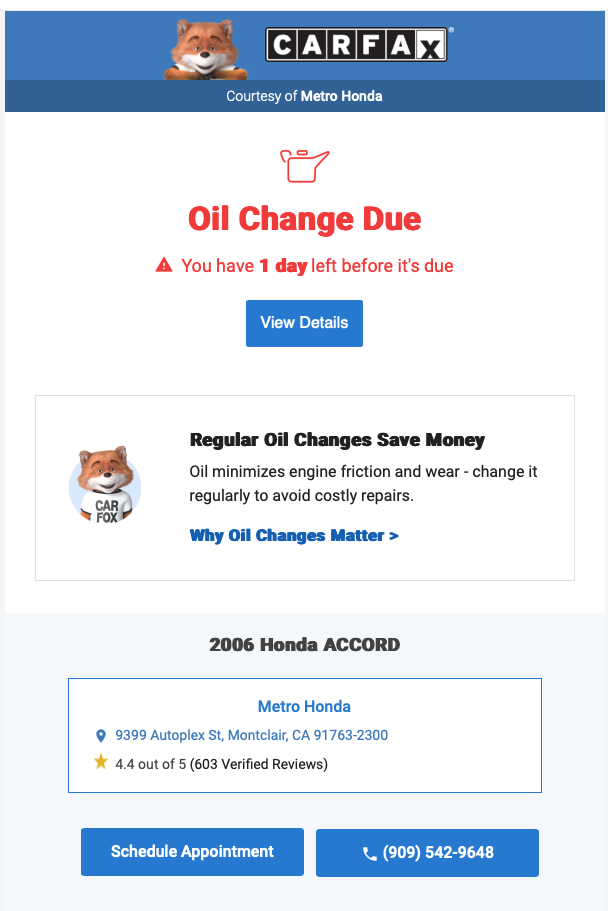
Later, I got a notice that I was due for an oil change. This was in August. That seemed odd to me, since I had just gotten one not long ago. I did a little clicking on links and discovered that this was based on my last oil change done by my nearby Honda dealer, Metro Honda. They had indeed done an oil changrs and based on their estimate of how long oil changes last, I could see how it would seem that I was due for another. I decided I wanted CARFAX to get the full story about my car and I filed a request for them to review the work done on my car by non-Honda dealer mechanics. I sent photocopies of the invoices for the non-Honda dealer work that had been done on the car.
They responded to my appeal, promising to look into it and get back to me. From time to time I would get email updates saying they were still investigating. Then, on the 10th of September, I got this:
Pretty scarey, huh? Gosh, I must be a very neglectful car owner who doesn’t care about his car!
PROBLEM: I don’t always get my car serviced at Metro Honda. Especially not for oil changes, which cost an arm and two legs at a Honda dealer and are much less expensive when done by an indepement autocare center or mechanic. In fact, my Honda’s info display showed that I still had 70% service life with the oil now in my crankcase.
And here’s the icing on the cake, from CARFAX:
_______________________
Dear Gregory,
CARFAX received your case. Use this reference number for follow up: #16772054.
The service location does not report their information to CARFAX, so we are unable to add the record to the Report.
Unfortunately not all service locations report information to CARFAX. If services were performed at locations that do not report their data to us, then we will not have those records on the Vehicle History Report. If you would like, you can invite service shops you’ve visited to report their records to us. From within CARFAX Car Care, choose a vehicle from the Garage and select the Service History tab. Next, select Invite Shop, search for the shop you’d like to invite, and choose the shop from the list.
If you need further assistance with your Car Care application, please contact our Consumer Affairs department at webhelp@carfax.com.
Kind regards, Kevin Resolution Manager CARFAX Inc.
Thank you for your patience.
_______________________
All their “help” is nothing but a SCAM! They want to have a monopoly position as THE ONLY TRUSTED SOURCE FOR THE CONDITION OF A USED CAR AND ESTIMATE OF ITS VALUE. THEY REFUSED TO RECOGNIZE THE VALIDITY OF THE INVOICES I SENT THEM, WHICH THEY ASKED ME TO SEND. WHY SEND THEM WHEN THEY JUST GET IGNORED?
Here’s why this is a BIG problem. Early next year I will be getting a newer used car. I will either trade in or sell my Honda to a private party. In either case, they will probably look up my CARFAX report to see how much my Honda is worth. And CARFAX does not have any record of most of the work I’ve had done on the car over the past year+. New motor mounts, new transmission mount, new front suspension, timing belt replacement done just after 200,000 miles (car now has 207,000+ miles), complete rouitine maintenace with new plugs, etc., new driver’s seat leather seat cover, new front tires and front end alignment, new head gaskets, recent oil change…and more!
Mechanically speaking, my Honda is a lot younger than its year and mileage say it is. But CARFAX says my car is worth only $1680. Looking at various used car listings, I would put the value at $1000 more.
And CARFAX wants ME to promote their service to independent service centers and mechanics? For free? As if I think this is all a great idea? Never going to happen.
The End.
________________________
Postscript:
I called Metro Honda and wanted to speak to their manager. I was transferred to the extension for their Used Car Manager. No answer, so I left a voicemail about my problem and asked for a call back. I didn’t get one. I will now be using a different Honda dealer if I need work only a dealer can do.
Here is an article that lists 10 psychological traits associated with going online. I’ve seen some of these in other posts, but having this list does a good job of cataloging what goes on when we go online. I hope you find it insightful.
A recent New York Times article goes in-depth to report on moms who manage Instagram accounts for their pre-teen daughters modeling clothes that draw pedophiles in droves. There ought to be a law!
What is wrong with these mothers? They KNOW what kinds of “men” are drawn to these sites. And it doesn’t seem to bother them in the least. And the youngsters aspire to be big-time “influencers” or “creators” as the more du jour term labels them. The sexualization of 11- and 12-year-old girls is, unfortunately, nothing new. Women who apparently have no life push their offspring into compromising situations in the pursuit of vicarious fame and fortune. A decade or two ago it was beauty contests. Now it’s social media coverage. Or, perhaps, UNcoverage.
It seems that segments of American society have shown that decadence is now fashionable and concepts like integrity and morality no longer have meaning. Caligula’s Rome is being surpassed as the exploitation of immature girls is allowed free rein.
“More Screen Time Linked to Delayed Development in Babies, Study Finds.”
Matt Richtel, writing for the New York Times, uses the above headline and opens his article with “One-year-olds exposed to more than four hours of screen time a day experienced developmental delays in communication and problem-solving skills at ages 2 and 4….” The study was published the same day in The Journal of the American Medical Association Pediatrics. Scary, yes?
He goes on to note, “The research also found that 1-year-olds who were exposed to more screen time than their peers showed delays at age 2 in the development of fine motor and personal and social skills.” A bit of good news: “But these delays appeared to dissipate by age 4.”
I went to the actual study, using the link that was provided by The Times. The study does not say that screen time caused the delay. It’s a case of correlation, not causation. The study’s authors said,
“Of the 7097 children in this study, 3674 were boys (51.8%) and 3423 were girls (48.2%)….” and concluded, “In this study, greater screen time for children aged 1 year was associated with developmental delays in communication and problem-solving at ages 2 and 4 years. These findings suggest that domains of developmental delay should be considered separately in future discussions on screen time and child development.”
Compare, if you will, paragraphs 1, 2, and 3 above that tell us what Richtel wrote, with what paragraphs 4 and 5 tell us the study’s actual authors wrote.
I hope you see, as I do, that Richtel is exercising the classic journalistic maxim: “If it bleeds, it leads.” That is to say, his coverage is rather alarmist and pursues the goal of attracting readership, as opposed to dispassionately providing useful information. And I suspect that he lacks a scientific understanding of the difference between correlation and causation.
So please, dear and gentle reader, when you see an article or listen to or watch a mainstream media story that seems to be reporting about some new scientific study, exercise due diligence and consult the source.
As we all stream more and more movies at home rather than go to the theater, many people are struggling to hear the dialog. The car crashes, gun shots, and fights come through loud and clear. The background music does its job to enhance the mood without distracting us from the action. But the dialog? Why is it so hard to understand what the actors are saying?
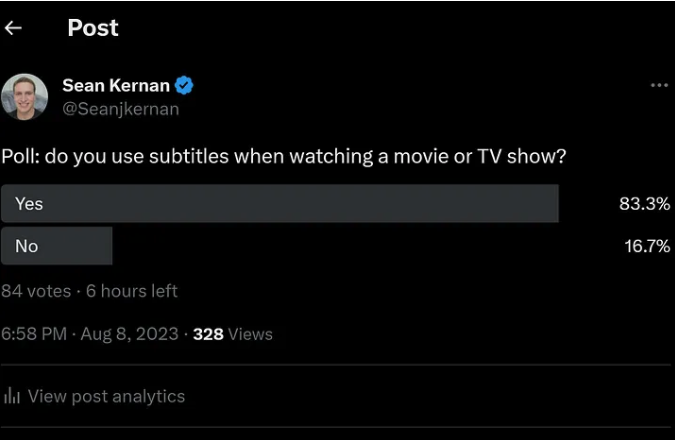
And I suspect that, like me, you are turning on subtitles to compensate for the seemingly poor sound quality. Writing for the online forum “Medium,” Sean Kernan posted this graphic:
Sean goes on to explain the three different kinds of sound—sound effects, music, and dialog—and how sound engineers struggle to find an acceptable balance, a task made more difficult by two other factors.
One is technology. If you’ve ever attended a live play, you know that the actors speak loudly and enunciate clearly to ensure that no one in the audience misses out on the verbal interplay. And those of you who have had experience with film or video production know that not so many years ago, there was a single boom mic above the actor(s) to catch the dialog and the performer(s) knew they had to speak clearly enough for the mic to pick up what was being said. These days, however, there are usually two boom mics, as well as myriad tiny mics cleverly hidden on the actor’s body that combine to make sure every sound is picked up. Unfortunately, however, this has led to performers mumbling their lines.
Turning up the volume on your sound bar is not going to help those mumbled lines become any clearer, as the sound effects and music get louder too, tending to drown out the dialog.
Factor number two is a combination of two things—the fact that sound recording and editing software isn’t standardized and that the sound engineer’s primary objective is to optimize the sound track for in-theater, big-screen viewing with the latest and greatest Dolby X.x sound systems.
Multiple sources vie with each other for sound software dominance and the result can be that what sounds fine with a recording being listened to on a complementary output system, doesn’t sound so hot on another speaker/amplifier combo.
And your 72″ OLED flat screen’s speakers are no match for a movie theater’s latest version of Dolby.
I recommend you read Kernan’s post for yourself. It’s a well-written and enlightening piece.
According to research done at the University of Cambridge, it’s Millennials and Gen Z’ers.
“University of Cambridge psychologists have developed the first validated ‘misinformation susceptibility test’: a quick two-minute quiz that gives a solid indication of how vulnerable a person is to being duped by the kind of fabricated news that floods online spaces,” starts the University’s June 28, 2023 post.
The researchers found “…that younger adults are worse than older adults at identifying false headlines, and that the more time someone spent online recreationally, the less likely they were to be able to tell real news from misinformation.”
The study was published in the peer-reviewed journal Behavior Research Methods. The polling results can be accessed at YouGov US website.
Are you gullible? Find out. Take the test yourself at https://yourmist.streamlit.app/, answering 20 true/false questions. The factual sources for the answers came from the likes of the Pew Research Center and Reuters while the false information was generated using ChatGPT version 2.
Dr. Rakoem Maertens, the lead researcher, said the results were “…eye-opening and alarming.” The post goes on to note that, “When it came to age, only 11% of 18- to 29-year-olds got a high score (more than 16 headlines correct), while 36% got a low score (10 headlines or fewer correct). By contrast, 36% of those 65 or older got a high score, while just 9% of older adults got a low score.” And Snapchat users were right only 4% of the time, the worst of the lot, followed by habitués of Truth Social, WhatsApp, TikTok, and Instagram.
It seems that in today’s America, Democrats all think that Republicans are racist hate mongers and Republican think that Democrats are radicals working to destroy the country. Why is that?
Anyone who has been paying any attention to what is going on is already familiar with the term “echo chamber,” meaning that each “side” tends to listen, watch, or read only content that reinforces their tendencies and biases. This is true but it is not sufficient to explain what is going on.
I have been subscribing to “Tangle,” an online publication written by Isaac Saul in which he discusses various issues of the day and presents three summaries, two with the views of the opposing sides of the issue at hand (e.g. abortion’s “pro-choice” and “pro-life”) and then adds his own two cents. I find him to be pretty even-handed in his analyses.
And on Friday he always publishes a special edition that is available only to subscribers. Today he started off with this headline: “Why do we hate each other?”
It’s a long read. Saul grants permission to subscribers to distribute his musings far and wide without any restriction, so I am not violating any copyrights here by including the entire content as a PDF.
He makes a very important point well into his piece: The media today are different than they used to be. Once they at least attempted to be objective, even though biases always seem to have a way to inject themselves into even the most well-intended reporting. But this is no longer true. Now the “mainstream” media have all become advocates. It’s the Washington Post vs. Fox News. There’s no middle ground.
And that’s bad for all of us. I don’t know what we can do about it, but as the old adage goes, the first step to overcoming a problem is to recognize that there IS a problem. Read this piece and I think you will see that problem quite clearly. You can download it if you like.
The report says “a highly sensitive period of brain development” happens between the ages of 10 and 19, coinciding with a period when up to 95 percent of 13 to 17 year olds and nearly 40 percent of 8 to 12 year olds are using social media. But the Advisory notes that frequent use of such platforms can impact the brain development, affecting areas associated with emotional learning, impulse control, and social behavior. Murthy has previously said he believes even 13 years old is “too early” for children to be using social media.
Murthy also says more research is needed and while there are good effects from social media use, the risks may outweigh the rewards.


 mediainmind